App development cost in Saudi Arabia and Egypt, and what really drives it
- Published
- Reading
- 8 min read
- Author
- Mohamed Magdy IbrahimFlutter Technical Lead
App development cost in Saudi Arabia and Egypt is set by scope far more than by country: how many platforms, which heavy features (real-time updates, payments, outside data), and how much sits behind the app in backend and dashboard work. Below is what moved the timeline on projects we actually shipped, set against the price ranges other agencies publish, each with its source and date.
We are Sync Squad, two engineers in Menoufia, Egypt, working remotely for clients in Egypt and the Gulf. We don't publish prices, so you won't find one of ours here.
What sets app development cost in Saudi Arabia and Egypt
Every quote is a duration multiplied by a rate. Rates vary by team and by country. Duration is set by scope, and scope is the part you control when you write the brief. In our projects, these are the things that actually moved the number of weeks:
- Platforms: iOS, Android, web, and whether you need an admin dashboard.
- Heavy features: real-time updates, online payments, third-party data feeds, AI.
- Arabic and English together, with right-to-left layout.
- The backend and dashboard the app runs on.
- Store publishing, then maintenance after launch.
Country changes the weekly rate. It barely changes the week count. A live-score app pulling from three data providers takes the same engineering in Riyadh as in Cairo.
One Flutter codebase still doesn't make the second platform free
We build each app from a single Flutter codebase that ships to both Google Play and the App Store. That saves writing every screen twice. It doesn't remove the per-store work: signing, TestFlight on iOS, the store listing, review, and the bugs that only show up on certain devices. Sound to Read, a phonics app for children, had to pass kids-category review on both stores, and each store has its own rules for that category.
The web is a different case. Escore runs on iOS, Android and the web from one backend, but the web front end, which Mahmoud built separately from the Flutter app, is a second set of screens to design, build and test. It adds far more time than the second store does.
Origami, a Saudi agency, wrote on 10 June 2026 that a shared codebase such as Flutter saves 30 to 40 percent over two separate native builds. That's their figure, not ours, though it matches what we see: the savings are in screens and logic, not in publishing.
Real-time, payments and data feeds are where weeks go
Google and Apple sign-in through Firebase is a well-trodden path. On Escore it accounts for 90% of registrations.
Real-time is the opposite. Escore pushes live scores and tournament brackets to the app over WebSocket while matches are being played. The backend my colleague Mahmoud Hamdy built has 16 modules and pulls data from three providers: PandaScore, GRID and Abios. Each provider meant an evaluation, an integration and code to reconcile its data shape with the others. Each live connection on a phone means handling dropped networks and reconnects.
Payments get underestimated. A gateway needs server-side confirmation, failure and refund paths, and testing in sandbox and then live. To be straight about it: we haven't yet shipped an app that takes payments. The only gateway in our work is Paymob in Bagour Delivery, which is still in development. If your app needs Mada or Apple Pay, we integrate it and scope it as its own line item.
Arabic and RTL are cheap only if they're planned from screen one
Right-to-left flips the order of elements, margins and directional icons, and every screen has to be checked in both languages. Escore switches between Arabic and English while the app is running, with full RTL. When both languages are in the plan from day one, this is translation files and a per-screen review: days, not weeks. Adding Arabic to an English-only app later can mean revisiting every screen.
The backend and dashboard are a large share of the bill
Escore's editors run tournaments, matches, rankings and news from a Next.js dashboard that sits on the same API as the app. That decision meant the data logic was written once. It didn't make the dashboard free.
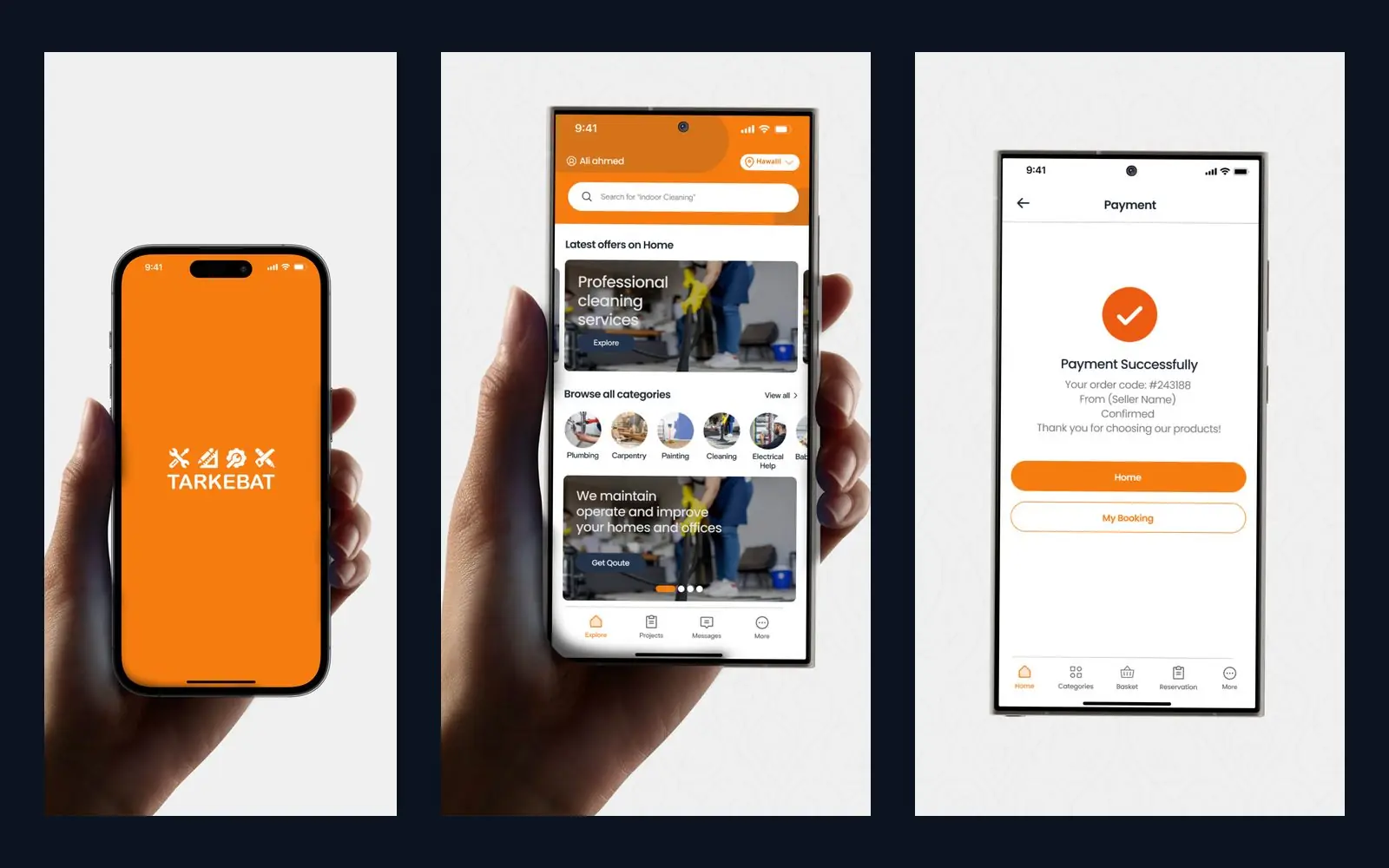
Some apps skip a custom backend altogether. Tarkibat, a services marketplace I built at PureSoft between January and March 2025, uses Firebase Authentication and Firestore for sign-in and data. That trims server work and suits plenty of apps, but it's a call to make on the shape of your data, not on price alone.
Three real projects, three very different timelines
Escore took about a year, August 2025 to August 2026, for Rov Group, a Saudi company: a Flutter app on iOS and Android, a web front end and dashboard built by Mahmoud, a 16-module real-time backend, three data providers, offline caching and two languages. Part of that year went to performance. Many of the region's esports fans are on slow networks and low-end Android phones, so we reworked the API integration and JSON serialization until the payload dropped 65% and API latency 54%. The app has passed 5,000 registered users.
Salamah Checker took two months, and it isn't a mobile app at all. Mahmoud built it for Esnad Al-Mudun: a Windows tool that checks permits in bulk on the Saudi Civil Defense Salamah portal across up to 30 parallel browser sessions. No store, no dashboard. Most of the effort went into reliability: checkpoints for pause and resume, retry with backoff, and 179 automated tests. The cost was in making long runs survive interruptions, not in screens.
Our fixed-scope MVP track runs 6 to 10 weeks: a Flutter app, its backend and an admin dashboard, live on both stores, built against a written feature list agreed before we start, with an installable build every week. For Sound to Read, I built and released the app between May and July 2025 for a Saudi client, and Mahmoud built the backend behind the lessons and parent reports.
After launch: store accounts and maintenance
Some costs go straight to Apple and Google: a yearly Apple Developer Program membership and a one-time Google Play Console registration. Those accounts are created in your name, and we work in them with the access you grant.
Then there's maintenance: OS updates, bug fixes, small changes. The agencies below put it at a yearly share of the build cost: 15 to 20 percent at Origami, 15 to 25 percent at TekRevol, 15 to 20 percent at Dev Technosys. On our side, we fix any bug in what we delivered, within the agreed scope, free for 30 days after launch. After that there is an optional paid monthly support plan, price on request.
What the market publishes, and who is behind the numbers
On 4 October 2026 I re-read four pages that publish app cost ranges for Saudi Arabia and Egypt. These are their figures, as published, not our prices:
| Publisher | Date | Simple | Medium | Complex |
|---|---|---|---|---|
| Origami, Saudi agency | 10 Jun 2026 | SAR 15,000–30,000 | SAR 30,000–80,000 | SAR 80,000–250,000+ |
| TekRevol, US agency | 28 Aug 2026, updated 31 Aug | SAR 30,000–100,000 | SAR 100,000–500,000 | SAR 500,000–1,000,000+ |
| Riseup Labs, Bangladeshi agency | 28 Feb 2026, updated 9 Jul | SAR 35,000–70,000 | SAR 70,000–170,000 | SAR 170,000–300,000+ |
| Dev Technosys, Indian agency, on Egypt | updated 9 Jul 2026 | EGP 309,006–463,509 | EGP 463,509–618,012 | EGP 772,561+ |
"Simple" means very different things. It starts at SAR 15,000 at Origami and reaches SAR 100,000 at TekRevol, and the Riseup Labs page gives a second, different range for a basic app (SAR 30,000–60,000) in another table. Origami at least says what it means: simple is a few screens with no complex integrations; medium adds user accounts, payments, notifications and an admin dashboard.
The Egypt figures need care. The only EGP ranges we found come from an Indian agency, and oddly exact numbers like 309,006 point to a currency conversion rather than a survey of Egyptian pricing. We found no Egyptian company publishing EGP ranges; Arabic searches about Egypt mostly returned freelance gig listings. So we don't offer an Egyptian range here, because we have no source worth quoting.
Before comparing two numbers, ask each provider exactly what theirs includes: the dashboard, the backend, store publishing, Arabic.
Why we don't publish prices, and how to get an estimate
A number without a written scope tells you little, as the table shows. Instead, our estimator gives a duration range in weeks from the project type, platforms and features you pick, and a written brief gets a specific offer back. Our Flutter app development page covers what the app work itself includes.
Send us your brief through the project form and we'll come back with a scope and a timeline.
Share
More on the same topic
| No. | Date | Article | Topics | Reading |
|---|---|---|---|---|
| 02 | Flutter Arabic RTL support: what a bilingual esports app taught me | 5 min read |